
A French industrial group, whose regional headquarters is in Bangkok, wanted to accelerate its digital transformation in Asia-Pacific. We helped it get clarity, bring the countries together around a shared vision and build a common roadmap.
| In brief | |
|---|---|
| Scope | Thailand, Indonesia, Malaysia, Japan, South Korea, Vietnam and Australia |
| Governance | A digital board with executives (C-level) |
| Organisation | 14 digital and data leads in the countries |
| Methods | Assessment, design thinking workshops, roadmap validated with OKRs |
| Duration | 12 months |
| Initiatives identified | 90, of which nearly 30% duplicates |
| Projects selected | 20, steered by 5 OKRs |
| Time to market | Reduced by 50% |
The context
Our client is a French industrial group present across Asia-Pacific, with a regional headquarters in Bangkok. The region was still new: until then, each country had moved forward on its own.
The digital environment reflected this history, on three levels that barely spoke to each other:
- a global technical foundation, run by the group from France;
- regional developments, run from Bangkok;
- numerous local initiatives, launched by each country with no link between them.
At the same time, competitors were accelerating their online sales, notably on mobile and on super apps, widely used in Southeast Asia. The pace set from Europe did not always match the practices and constraints of each market.
The challenge
The first challenge was to get clarity. Between the group, the region and the countries, nobody had an overall view of what existed, what worked and what was missing. More than 40 people were involved, without knowing what the others were doing.
Three obstacles added to this:
A technology-centred vision
Teams thought of transformation in terms of tools and BI reports, without starting from business needs.
A siloed organisation
Business, technical and country teams worked in silos, with technical teams located in another country.
No common language
Everyone talked about digital transformation, but nobody was talking about the same thing.
A digital transformation changes the customer experience, processes, business model, skills and culture of the company. Before talking about solutions, we therefore had to identify where the frictions were and where we wanted to create value.
Our approach
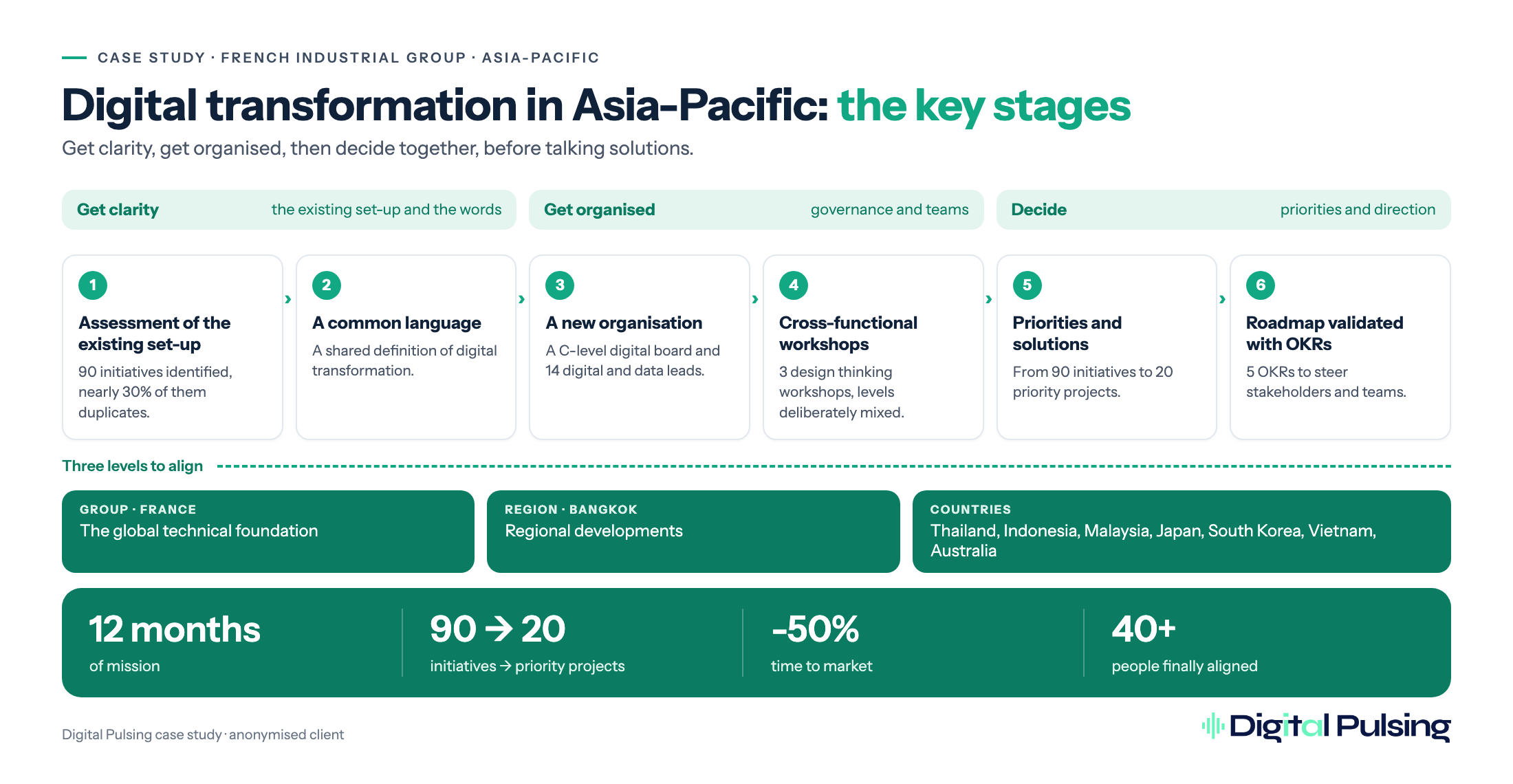
We started with the assessment and the organisation, before talking about solutions.
1. An assessment of the existing set-up
We mapped the whole digital environment, at group, regional and country level: tools, projects, teams, data and uses. This assessment identified 90 initiatives, of which nearly 30% were duplicates, and highlighted strong disparities between countries.
2. A common language
With the teams, we defined what “digital transformation” meant for the company. This common foundation let everyone, from headquarters to the countries, share the same vision and ambition.
3. A new organisation
We built an organisation around two pillars:
- a digital board, with executives (C-level), to carry the vision and arbitrate priorities;
- 14 digital and data leads, spread across the countries: Thailand, Indonesia, Malaysia, Japan, South Korea, Vietnam and Australia. Each lead understands the value chain end to end and links the field to the region.
4. Cross-functional design thinking workshops
We ran three design thinking workshops, first with the leadership team, then with the tactical and operational teams, whom we mixed together. Goal: break down silos and build a shared vision of the transformation together, starting from frictions and sources of value.
5. Priorities and solutions
We drew up the inventory of priorities and possible solutions, in close collaboration with the technical teams based in another country. We assessed each option on the value it creates and its realism for each market. Of the 90 starting initiatives, 20 projects were selected.
6. A roadmap validated with OKRs
We identified the stakeholders, formed the teams and built the roadmap. It was validated with 5 OKRs (objectives and key results), so that the regional headquarters and each country know what they must achieve and how to measure it.
The results
- From 90 scattered initiatives to 20 priority projects, after removing nearly 30% duplicates.
- A 50% shorter time to market thanks to clear priorities and aligned teams.
- A shared roadmap, steered by 5 OKRs.
- Regional governance, carried by a digital board at the highest level.
- 14 digital and data leads, linking the field and the strategy.
- A common language on what digital transformation means for the company.
- A shared conviction: digital transformation, e-commerce in particular, must be thought through end to end.
Countries that used to move forward on their own now work together and share good practices.
Key takeaways
- The first topic is identifying frictions and sources of value.
- Speak the same language. Without a common definition of digital transformation, everyone moves in their own direction.
- Transformation goes beyond technology. It touches the customer experience, processes, business model, skills and culture.
- Local leads provide the link. In a region as diverse as Asia-Pacific, each country has its own practices, constraints and pace.
- Mixing levels breaks down silos. Executives, managers and operational staff build better together than separately.
Do you manage several countries and want to align your digital transformation? Let’s discuss your project in a 30-minute conversation. Together we will look at your situation and the first actions to take.
Free, in 2 minutes, instant result